
AEM’s Sling Framework: Understanding Component Resolution and Rendering
To understand how Apache Sling resolves components on an AEM page, it’s helpful to walk through the process using the CRX/DE (Content Repository Extreme/Development Environment) in AEM. Let’s use the example of a page with two components, Text and Button, accessible at http://localhost:4502/editor.html/content/we-retail/language-masters/en/test-page.html. We’ll see how Sling resolves these components and how you can follow this path in CRX/DE for debugging or learning purposes.
How Sling Processes the Request:
- When the page URL is requested, Sling resolves the path
/content/we-retail/language-masters/en/test-pageto the JCR node. - Sling then reads the
sling:resourceTypefor each component on the page and executes the corresponding scripts. - The output from these scripts (HTML, CSS, JavaScript) is combined to form the complete page, which is then sent back to the user’s browser.
Step-by-Step Guide through CRX/DE:
Access CRX/DE:
Navigate to http://localhost:4502/crx/de/index.jsp on your AEM instance. This is the CRX/DE interface.
Locate the Page Node:
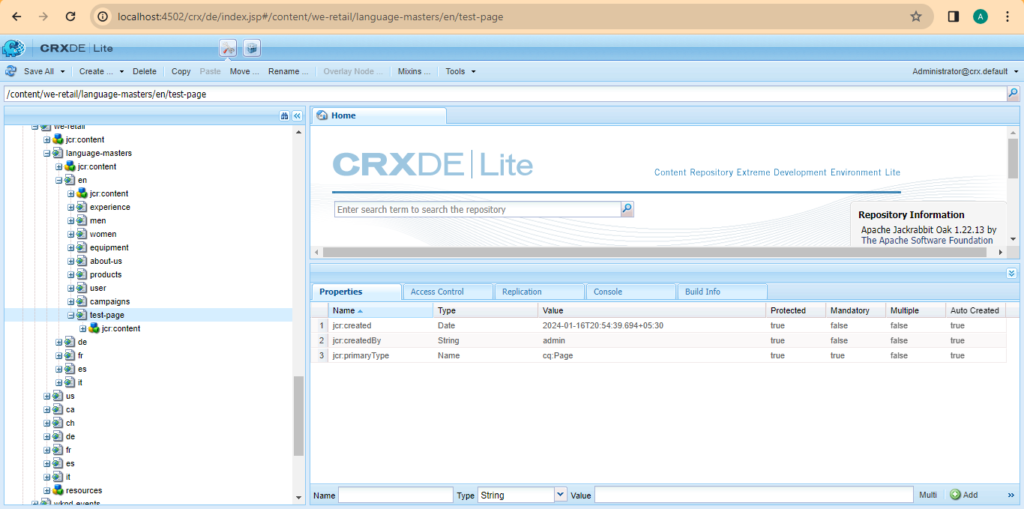
- In the CRX/DE, navigate through the repository tree to find the node corresponding to your page. In this case, follow this path:
/content/we-retail/language-masters/en/test-page. - This node represents your AEM page in the JCR.
- Child Node
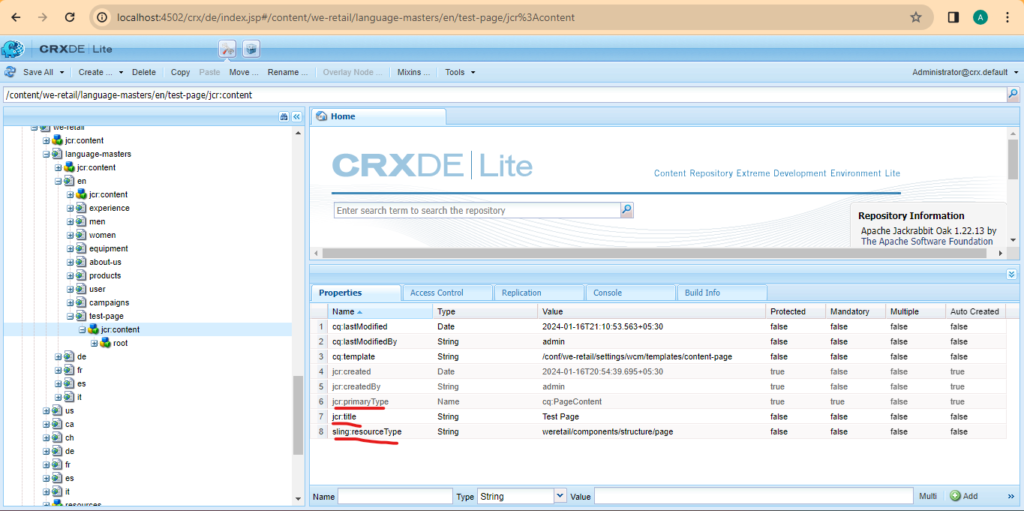
jcr:content: The crucial properties, includingsling:resourceType, are not directly on the page node but on its child nodejcr:content. So, navigate to/content/we-retail/language-masters/en/test-page/jcr:contentto view these properties. - Click on th
e child node jcr:contentnode. You’ll see various properties set for this page, including thejcr:primaryType,jcr:title, and potentiallysling:resourceType. - The
sling:resourceTypeproperty typically points to the page component used to render the page layout.
Identify Component Nodes:
- Within the
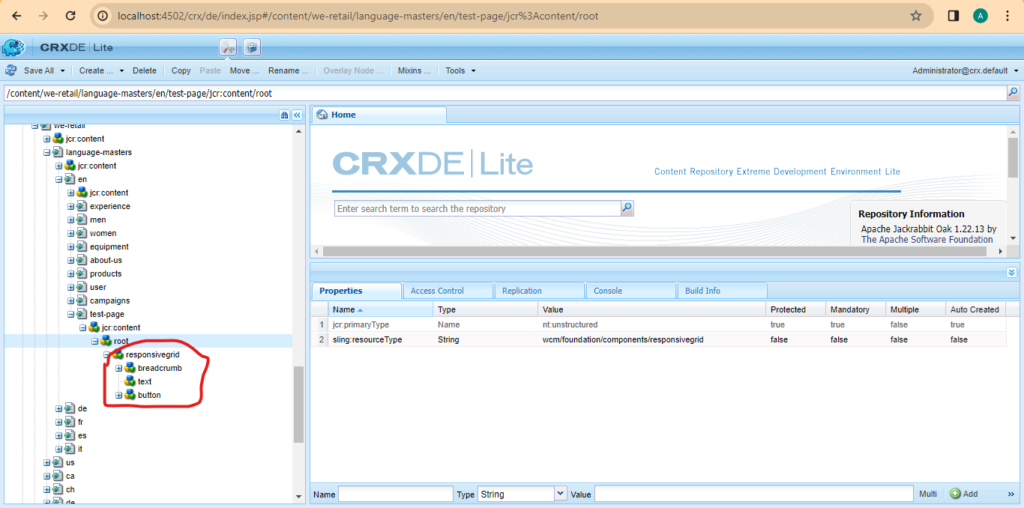
test-pagenode, look for child nodes representing the individual components on the page – in this case, the Text and Button components. - These might be nested within other nodes, like
jcr:contentor a layout container node.
Inspect Component Nodes:
- Click on the nodes representing the Text and Button components.
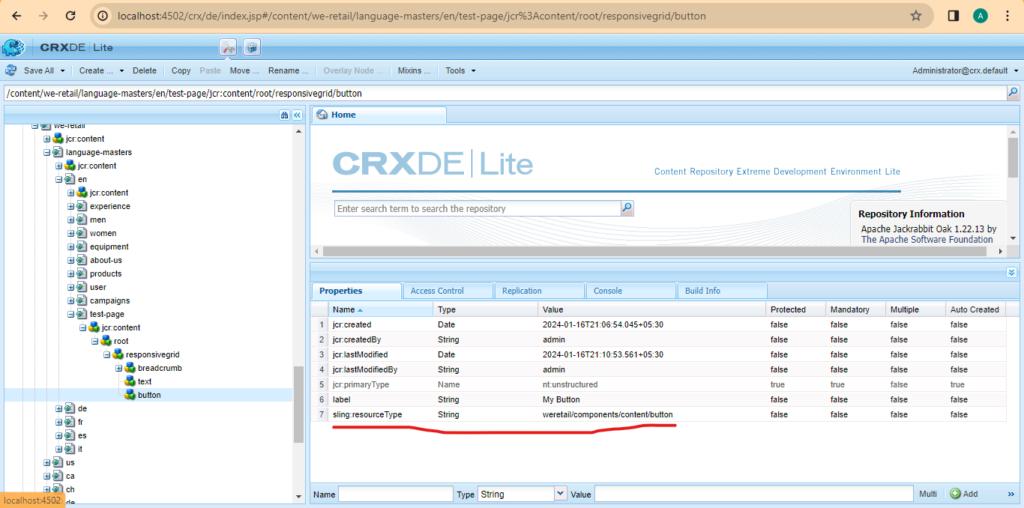
- Note the
sling:resourceTypeproperty for each. This property is crucial as it tells Sling which script to execute to render these components. - For instance, if the Button component has a
sling:resourceTypelikewe-retail/components/content/button, prepend/appsto it, making it/apps/we-retail/components/content/button.
Tracing Component Scripts
- The
sling:resourceTypevalue is actually a path in the JCR. Navigate to this path in CRX/DE. - Here, you will find the scripts (usually HTML, possibly with HTL/Sightly, JavaScript, and CSS) that render the component.
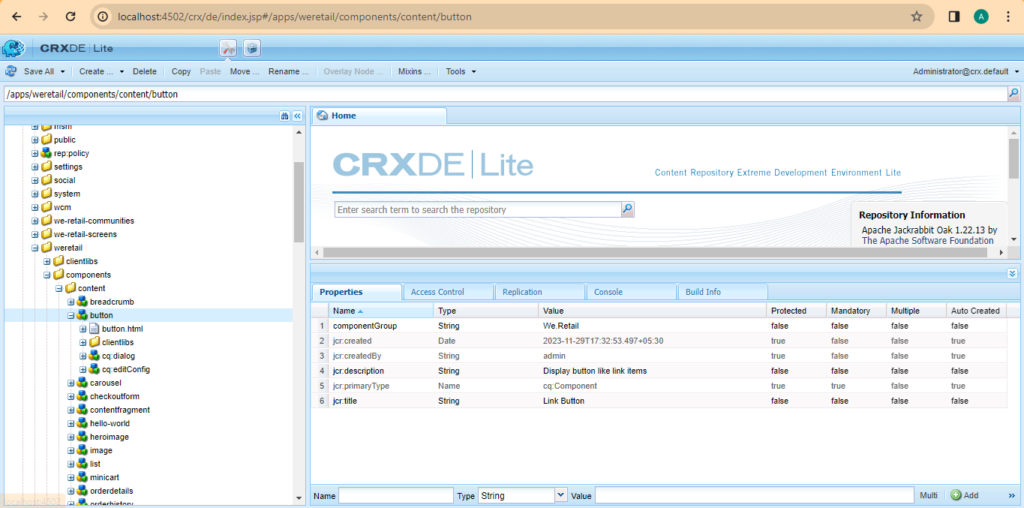
- Navigate to the path indicated by
sling:resourceTypein CRX/DE. For the Button component, this would be/apps/weretail/components/content/button. - If you don’t find the HTML script at this location, check the
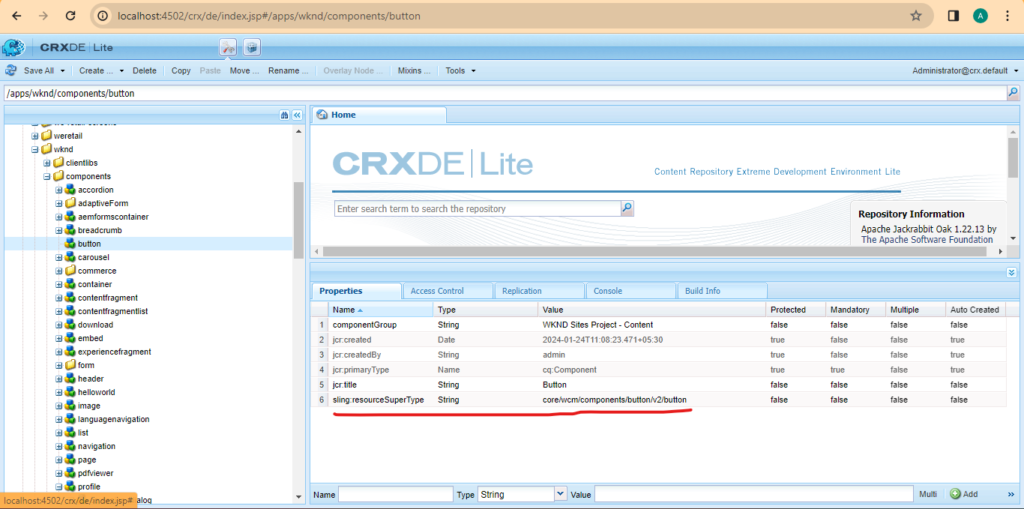
sling:superResourceTypeproperty. This property points to another path where the script might be located. Again, prepend/appsto this path.
Understanding Component Overriding
The use of sling:superResourceType is important in AEM for component overriding. It allows customization of components without altering the original component scripts. This ensures that updates to the base component don’t overwrite customizations.
The Content-First Approach of Sling Framework
Content-First Approach:
- The Sling framework follows a content-first approach. This means Sling resolves the requested URL to a corresponding content node in JCR.
- It emphasizes the importance of the structure and organization of content in the repository. The URL mapping directly to JCR nodes ensures that content is easily accessible and manageable.
Benefits of Content-First Approach:
- This approach ensures a seamless connection between the URL and the underlying content structure.
- It simplifies content management, making it easier for authors to update and maintain the site.
- Enhances the flexibility of content delivery, allowing for dynamic rendering of pages based on the content structure.
Conclusion
By walking through this process in CRX/DE, you gain a deeper understanding of how Sling processes requests in AEM, the role of component properties like sling:resourceType and sling:superResourceType, and the overall content-first approach that underpins AEM’s content delivery mechanism. This knowledge is vital for effective debugging, customization, and development within the AEM environment.